High Availability: Storage
CommunityEnterpriseIn this article, we analyze the architectural HA options for the Bacula Storage component, which consists of three main elements:
The Bacula Storage service
The Bacula Configuration (a directory with text files)
The managed backup data
Similarly to the Director service, High Availability can be established by treating the three of them together, or by separating them.
Storage Protection Foundation
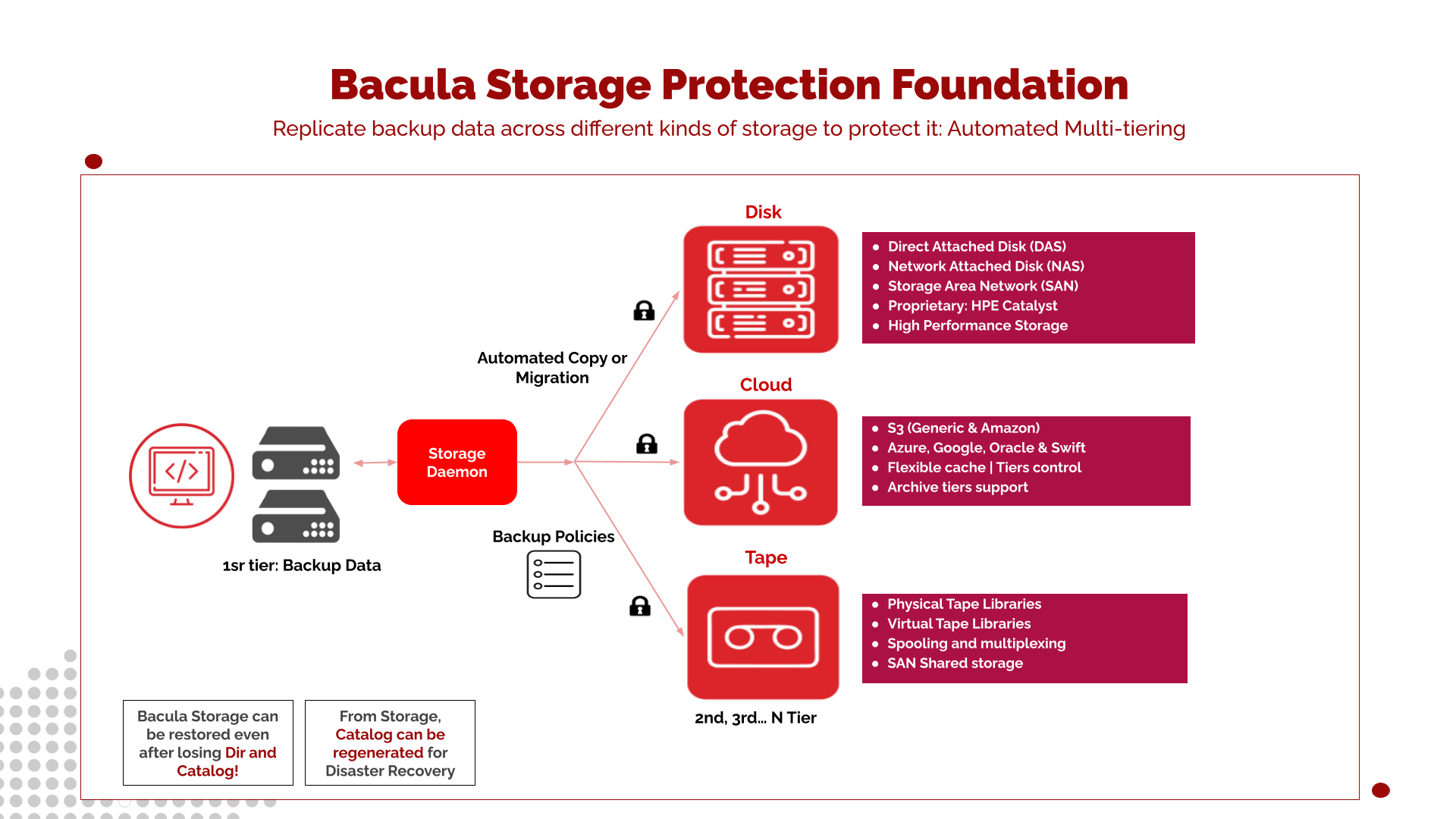
In any backup architecture, the most critical asset to protect is the backup data itself. While high availability for services such as the Director or Catalog is important for operational continuity, what ultimately matters is ensuring that the data stored in backup repositories remains intact, recoverable, and resilient against failures or malicious events. This is the main goal of software like Bacula, where a robust and resilient architecture is empowered natively.
In this context, implementing a robust multi-tiered backup strategy is essential to achieving true data resilience. This strategy involves storing data across multiple storage layers and physical locations, for example:
High-performance disk-based repositories
Secondary storage tiers (slower disk, object storage, cloud)
Offline or air-gapped media such as tape
Geo-distributed storage for disaster recovery
Bacula makes these strategies straightforward through built-in policies and job orchestration. Administrators can use:
Schedule resources to automate recurring workflows
Copy Jobs and Migration Jobs to duplicate or move backup data across different storage devices
SD-to-SD replication to synchronize Storage Daemons efficiently, even across remote sites
These mechanisms allow organizations to implement multi-tiered, multi-location retention policies with minimal complexity, significantly strengthening recovery capabilities.
While security considerations such as data integrity validation, immutability, and anti-ransomware measures are outside the scope of these High Availability articles, they remain essential pillars of a complete data-protection strategy. Readers are encouraged to consult other sections of Bacula’s documentation for further information.
Another important capability of Bacula is that data remains recoverable even if the Director or Catalog is compromised. Backup data stored in repositories is self-contained and can be restored directly from the underlying media in disaster recovery scenarios. Specifically:
The Catalog can be reconstructed from existing backup volumes
Data can be extracted even if the Director service is unavailable
Disaster Recovery workflows allow administrators to rebuild essential metadata and restore operations
This capability ensures that the loss of the Director or Catalog does not equate to the loss of backup data, a key requirement for enterprise-class resilience.
Backup Data Replication
Many of the techniques used to provide high availability for the Bacula Director can also be applied to Bacula Storage Daemons (SDs). The goal is to ensure that both the configuration and the backup data remain available in the event of node failures.
Configuration Replication
The configuration of a Storage Daemon can be replicated to a remote SD using block-level replication technologies such as DRBD. The process mirrors the approach used for Director HA:
A master SD actively serves backup requests
Configuration changes are automatically synchronized to a standby SD
Failover to the standby occurs automatically if the primary becomes unavailable
Because the configuration data is typically small compared to backup volumes, replication is lightweight and highly efficient.
Data Replication
DRBD can also be extended to replicate the underlying storage data between SD pairs. In this setup:
Two Storage Daemons are configured in a master/slave relationship
Block-level changes on the primary SD are replicated to the secondary SD
Automatic failover ensures that the standby SD can take over immediately with minimal service interruption
This approach provides a transparent, high-availability layer for storage, similar in principle to the Director’s HA architecture.
Depending on operational requirements and infrastructure, other replication or synchronization tools can be used. For example:
Rsync (https://github.com/RsyncProject/rsync):
It is efficient for incremental file-level replication and useful when block-level replication is not necessary or feasible.
High-End Filesystem Features (e.g., ZFS)
ZFS send/receive commands enable remote filesystem replication
ZPOOL replication can create mirror-like pools or RAID-Z systems, providing built-in redundancy at the storage layer
These are only examples; many other software-managed replication techniques exist. Such approaches may reduce or eliminate the need for additional hardware RAID controllers.
These options allow flexibility in designing HA Storage Daemon architectures, balancing performance, complexity, and cost according to business needs.
Backup Data Replication: Shared Storage and Bacula Storage Groups
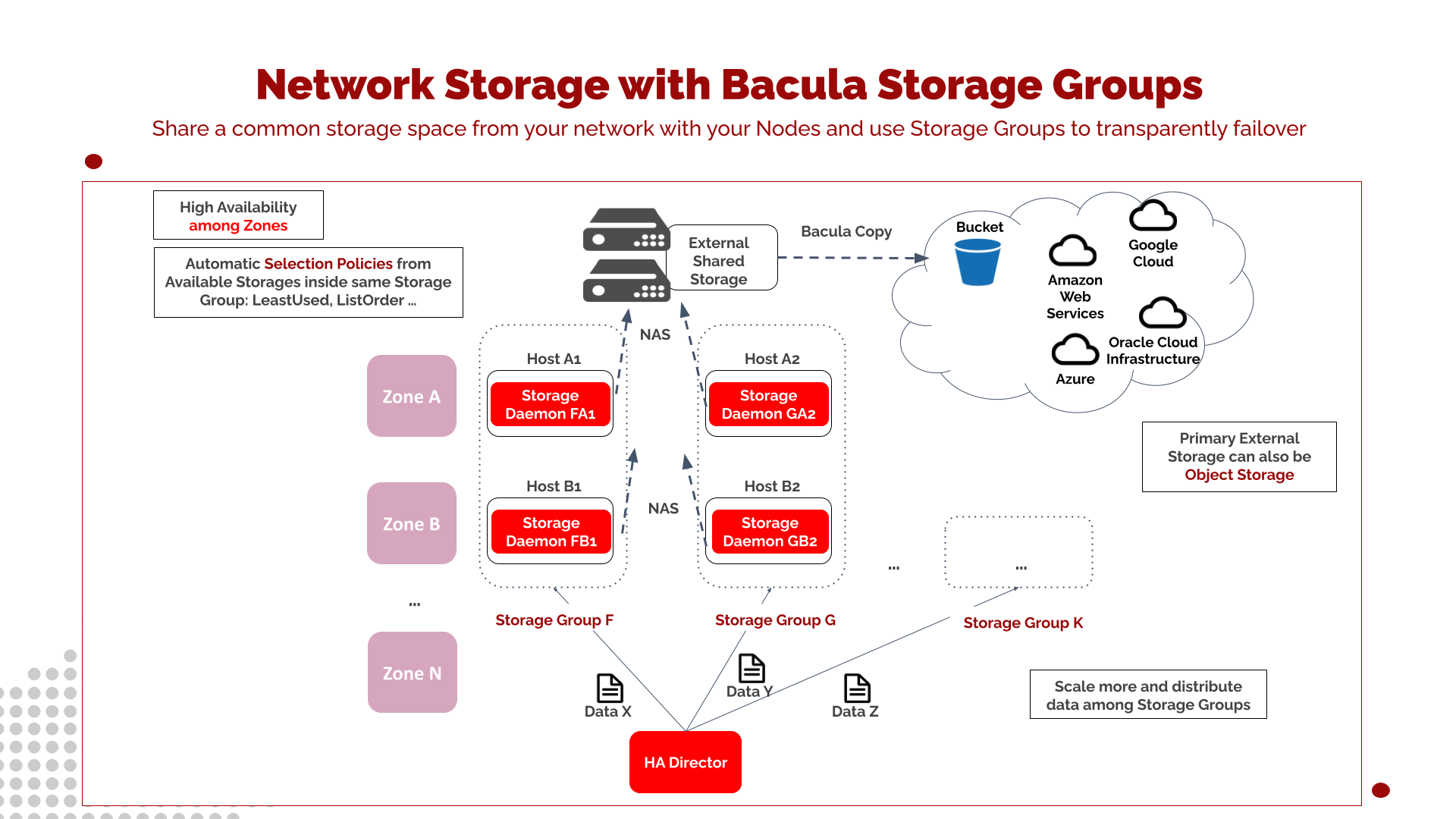
As highlighted in the introduction, Bacula itself is a powerful tool for replicating backup data. Leveraging Bacula for storage-level high availability reduces the need for additional clustering or replication infrastructure while ensuring consistent data protection.
Multi-Tiered Backup Strategy
After achieving HA on the primary storage layer, it is strongly recommended to implement a multi-tiered backup strategy, copying data to additional storage targets to increase resilience and disaster recovery capability. These secondary targets can include:
Remote disk-based storage
Tape libraries or tape-as-a-service solutions
Cloud or software-defined storage (SDS) platforms
This tiered approach ensures that backups remain recoverable even in the event of a site-level failure or catastrophic event affecting the primary storage.
Operational Advantages
Using Bacula for both HA and data replication provides several key benefits:
Integrated Monitoring: Replication and high-availability processes are fully monitored through standard Bacula tools, just like any other backup job.
Simplified Architecture: There is no need to deploy additional clustering or replication software for Storage Daemons, reducing operational complexity.
Flexibility and Control: Storage Groups allow administrators to manage data placement, redundancy, and failover behavior at the backup application layer, providing greater control over replication policies and recovery procedures.
By combining shared storage, Storage Groups, and multi-tiered backup policies, Bacula delivers a robust, software-defined HA and replication framework for backup repositories without introducing unnecessary complexity into the infrastructure.
See also
Previous articles:
Next articles:
Go back to: High Availability.